Surprise!

My birthday was a couple of weeks ago. It usually passes with three birthday cards (my Dad, my husband, and a longtime friend who never forgets). The weekend before, my husband (a woodworker) was going to pick up some wood from my brother’s house and asked me if I wanted to go along for the ride. I accepted eagerly — I don’t get to visit with my ebrother and his wife often enough through the year, and when they heard I was coming with Bill, they invited us to lunch.

After the usual 90 minute drive, we walked in the door. . . “Surprise,” they yelled. My brother and his wife, my sister and her husband, my 94 year old Dad, and Bill had planned a surprise party for my 70th birthday. And I had had no idea — really!

Now, for some folks, a surprise party might not be a big deal — for some, it might be annoying, especially for a big birthday like 70. To me, it was a huge and welcome thing. I still have the balloons tied to a chair in my dining area — 7 foil balloons of different shapes and messages. “One for each decade,” my brother bragged.

There were cupcakes of a variety of colors, flavors, and icings. There was pizza from the local pizza place. Simple. Unpretentious. But so very affirming that I was loved and cared about. And that warmth and glow fills my heart each time I think of the shout of “Surprise!”

I am noticing a difference in myself since my retirement last summer. Retirement agrees with me and I have had no trouble “adjusting” to it. What has most touched me is the slowing down of time and schedules. I used to feel (most of the time!) that I was running behind — a consistent feeling of having so much to complete but never quite being on top of things — never quite completing what needed to be done. I always got things done — sometimes by the skin of my teeth — but never felt that I finished tasks with time to savor their completion. In retirement I still have things to do (retreats I’m leading, doctors appointments, working out, making connections with friends) but my life feels more leisurely.

A friend of mine says it this way, “I have things to get done, but there’s always tomorrow.” At least it feels like there’s always tomorrow.

I’m cognizant of taking time seriously because I can never know if today will be all I have. But what I am experiencing at this stage of my life is that life can be more leisurely than pressured.

I told myself that I would know I was ready to retire when I felt that my life in the world had made a difference to others. I feel I have made a difference — though not in dramatic ways. I’ve made a difference in small ways in many peoples’ lives. My “rainy day” file teaches me that as I read through two file drawers of notes, emails, journals that offer thanks to me for counseling help or sermons that “landed” or something I said (most of which I don’t remember). I studied and worked at professions that were intended to serve others. And I have served others — sometimes very well, sometimes not — but always that was the intention. And I still find ways to serve, but not with frenetic pressure on myself.

All this is to say that the difference I notice (that I mentioned above) is an ability to be present with others, to trust and accept their love/friendship/ caring. Letting love into my heart and basking in it is new to me (believe it or not). And I am grateful for this softening, letting in, and trusting. It is a true gift from God!

In Grief — You Are Not Lost

Lost
Stand still. The trees ahead and bushes beside you
Are not lost. Wherever you are is called Here,
And you must treat it as a powerful stranger,
Must ask permission to know it and be known.
The forest breathes. Listen. It answers,
I have made this place around you.
If you leave it, you may come back again, saying Here.
No two trees are the same to Raven.
No two branches are the same to Wren.
If what a tree or a bush does is lost on you,
You are surely lost. Stand still. The forest knows
Where you are. you must let it find you.

 –David Wagoner . Collected Poems 1956-1976

A friend of ours died last week of FTD . . . Fronto Temporal Dementia. FTD is an awful disease that steals yourself – who you are, your personality, your values — and leaves you with your memories fairly intact (unlike Alzheimer’s dementia).  It was awful to watch him lose himself as the disease took hold.  Scary,  heartbreaking, unreal . . . almost like he was possessed by some spirit that took over his body.  His wife and son and daughter-in-law cared for him at home, eventually having to install locks on the refrigerator and cabinets to prevent him from ravenously eating everything — literally.  He wandered and they had to follow him or distract him every moment.  This man who had been a well known photographer and collector became unable to hold his camera still and uninterested in his art.  He was unaware of others’ feelings and uncensored in what hurtful things he said to his wife and son.  

Hospice came and helped with his care a couple of times during the week, and offered one week of respite care so his wife could leave his side and try to escape for a brief time the nightmare that was closing in.

After 10+ years the nightmare ended with our friend’s death.  But for his wife, it continues.  She lost her husband long before he died.  She felt her grief had already overtopped any measure and that after he died there would be relief.  Instead, waves of grief accosted her relentlessly.

When she called me panicked at the myriad of feelings she was experiencing, I was able to reassure her that she was not going crazy.   I, too, had grieved the death of a spouse and knew the terror of uncontrollable and unwelcome feelings that come after the death of a loved one. . .sadness, emptiness, anger, confusion, restlessness, inability to concentrate.  All of them normal, and all of them horribly uncomfortable.  And all of them making the griever question one’s sanity and whether there is enough strength and energy to withstand the waves of feelings.

What surprised me as her friend was not the intensity of her feelings, but my realization that I knew at a gut level that this was not the ending of her ordeal but the beginning.  She would be in for a difficult and painful ride that no one could take away. 

Grief takes us and wrings all the energy and hope out of us, leaving painful empty spaces that we can only fill over time.  Over time, the aches of those empty places fill with new friendships, experiences, goals, hopes that soothe and nurture our emerging self.  And we reclaim and integrate into ourselves “old” parts of ourselves that fit whom we have become.  It is not a painless process but a kind of re-birth/resurrection that comes of the grief process.  

It helps to understand grief as a dual process oscillating between a painful letting go of what was and a dawning of new identity and energy.  It is not something we can “manage” except by allowing the waves of letting go roll over us (knowing they will not last forever) and enjoying the moments of energy and joy (knowing they will come more frequently and eventually become a new normal).

Blessings on all who are in grief this day.  Although a part of you has died — yet a part of you is being reborn.  I promise you.


Miracles

It is November 15 and the snow is falling rapidly.  We’ve already exceeded the initial accumulation projections of 1-3″.  The forecasters are continually upgrading one inch at a time.  We are now likely to receive up to 8″

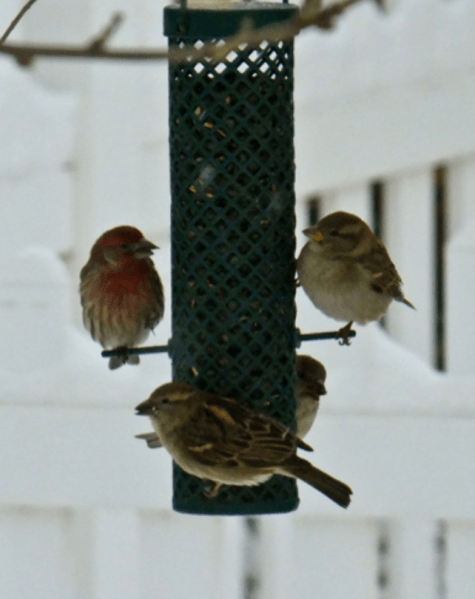
Finches feeder

Luckily, I’m enjoying the first snowfall of my retirement — I can stay home and watch the birds hassle each other over the seed in the feeders, and put on my traditional pot of chili that I always make on the first day of snow.

What a miracle it is to be able to watch the delicate flakes accumulate in soft piles.  What a blessing to watch the different species of birds with various colors accenting their feathers and differing patterns of spots/stripes/stippling on their bellies.  The goldfinches are my favorites.  They are emptying the niger and thistle feeder as I write.  All 6 perches are occupied and pity the poor bird who takes a moment to turn her head away from the seed port to survey the hungry birds waiting their turn.  She is likely to be divebombed by an anxious juvenile who has decided not to wait politely for her to finish, but to scare her off her perch and claim it for her own.

What a miracle to see clearly with eyes enhanced by glasses.  To see without the cloud of macular degeneration or the blindness of glaucoma.  It is a miracle to see the varieties of birds and to identify and name them one by one:  house finches, juncos, tufted titmice, black capped chicadee (gymnasts of the feeder crowd), cardinals, tanagers, and more.

Gratitude fills me as I sit here watching.  May I remember the miracle of this time of life, of clear sight, of a snowy day with no where to be except watching the buffet and its takers outside.

From Curiosity into Love

The surprises I’ve experienced in my writing practice have dislodged me from curiosity into love.           –Layli Long Soldier                                                                 (Lakota Poet interviewed by Krista Tippett)

Curiosity

I have taught counseling students that their initial attitude toward their clients upon the first meeting should be curiosity.  Curiosity about someone requires a stance of unknowing.  One who enters a relationship of any kind with curiosity is saying, “I want to know you.  I am listening.  I don’t know who you are and what you love, what you think, what soothes you, what scares you.  I want to know.  I’m here.  Please share what you can.”

The stance of curiosity in a counseling relationship, or any intimate relationship, is something that usually has to be learned and practiced because it doesn’t come naturally.  I believe most of us most of the time encounter another person whom we don’t know assuming something about them.  Almost unconsciously, we look at a person, at the clothes they are wearing, at their grooming, notice the color of their skin, their posture . . . and we make assumptions about this person.  Our amygdala at work, probably, sizing up another being to see if there is threat or not.  It is normal — I do it, you do it.  And in itself this automatic reaction is not bad.  It is only destructive if it is unconscious and not brought to our awareness.  Unconscious assumptions cannot be challenged nor evaluated for accuracy.

In therapy, if we therapists are not aware of our assumptions about a client, we cannot be helpful to them.  Our curiosity is a part of the healing skills we offer as we help them explore, discover, and tell us who they are.  They then can make courageous choices that are more consonant with who they know themselves to be.

As we participate in the process of learning one’s own story and honoring one’s identity,  our curiosity often becomes love.  By love I mean deep resonance and respect for another’s willingness to explore what may be painful experiences or choices.  Knowing someone deeply (as our curiosity and the other’s trust allows us to do) opens the door for loving the humanity, courage, and trust that another may place in us.  

I am grateful to the many clients and directees who have allowed me to witness to their journey toward wholeness.   Through my work as therapist and spiritual director the capacity to live my life with greater curiosity and love in all my relationships continues to grow and change me for the better.

Truth

The hardest part of writing is telling the truth.       –Sue Monk Kidd

I have not written lately, and perhaps I have lost you, my reader.  I have been painfully following the latest news commentary on the confirmation hearings for Supreme Court justice and the chaos that has ensued from the appearance of one and now two women who are accusing a potential Justice of sexual assault.  It has been disturbing and upsetting to me as it triggers memories I don’t want to remember.  

The memories are not new.  But I had buried them after each of them happened  — not even realizing what they were and not naming them sexual assault or sexual misconduct because I felt ashamed and responsible for not preventing them or knowing they might happen if I were in a certain situation.  As though I should have had a bit of God’s omnipotence to know what was about to happen.

The first I remember was when I was 16 and working a few hours a week as a cub reporter at our small town daily newspaper.  My editor assigned me to cover a Veterans Day Parade and I was to ride in a car with a 60-ish VFW member.  I climbed in the front seat, dressed in a modest Sunday dress and with my wooden pencil and lined notebook in hand.  As we drove the parade route, windows up because of the November chill, my “host” asked my name and grade in school and how our football team was doing.  I thought we were having a normal conversation and answered his questions.  In the same tone of voice, he said he had always wondered what color pubic hair a blonde and a red head had, did I know?  I could feel myself blush scarlet.  I felt stunned.  Was this ok? Is this how older men talk?  What should I do or say?  I stared at my lap and squiggled a doodle on the tablet.  “Well?” he said.

I had never been on a date.  I was very shy.  Writing was my outlet — I was much more comfortable with writing than with conversation.  I was a pastor’s daughter whose upbringing taught me that I was to make others comfortable and always try to understand things from other people’s point of view rather than challenge or disagree with them.  And I had learned those lessons well.

“You’re awful quiet over there,” he chided.  “And awful pretty.”  

I had never felt pretty.  I just wanted to get out of the car and run.  But “try to understand and don’t challenge him” were what came naturally at that point.  

“I don’t know the answer to your question, Sir,” I said without looking at him.  

He continued asking lewd questions.  I sat with my head down and tears coming and praying for the end of the ride.  We finally arrived at the VFW where the parade ended.  He invited me to go in to the bar with him.  Without looking at him, I opened the car door, jumped out, and ran and walked a block toward Teti’s pharmacy where there was a pay phone to call my Dad to pick me up as promised.

Until now, I never told this story except to my sister and husband.  And the awful thing is that it lay buried deeply in me until #MeToo burst on the scene.  Only then did I recognize it as the first of many boundary violations that have happened to me.  I was lucky, I know, that this was only words and not a rape attempt.  But the feeling of being trapped in that car, with a man whom I was supposed to trust as a benign helper in my cub reporter job while he enjoyed my discomfort with sexual innuendoes stays with me today.  It was the beginning of not trusting men, avoiding being alone with them, and feeling like a 16 year old when I have to be.   

Why is it so hard for so many men to understand the impact of the much more serious traumas that Dr. Ford and Ms. Ramirez are telling them?  Why must so many people minimize their stories as “just horsing around” — or worse yet, made up?  I know some of you who read this will figure that it is just “politics as usual.”  I want to know: what does it take to listen to someone with compassion and allow yourself to resonate with the feelings that come from such horrid events, however “insignificant” they may seem?

Jane+

We Are Pilgrims

What matters most on your journey is how deeply you see, how attentively you hear, how richly the encounters are felt in your heart and soul.

                                                                      –Phil Cousineau in The Art of Pilgrimage

I’ll be offering a workshop on Pilgrimage at the Center for Spiritual Awakening in Allentown PA October 6.  Yes, preparation for any presentation is takes effort, energy and time.  But when I talk about Pilgrimage, I find myself energized and excited to be introducing this spiritual practice to those who may soon be taking their first pilgrimage.

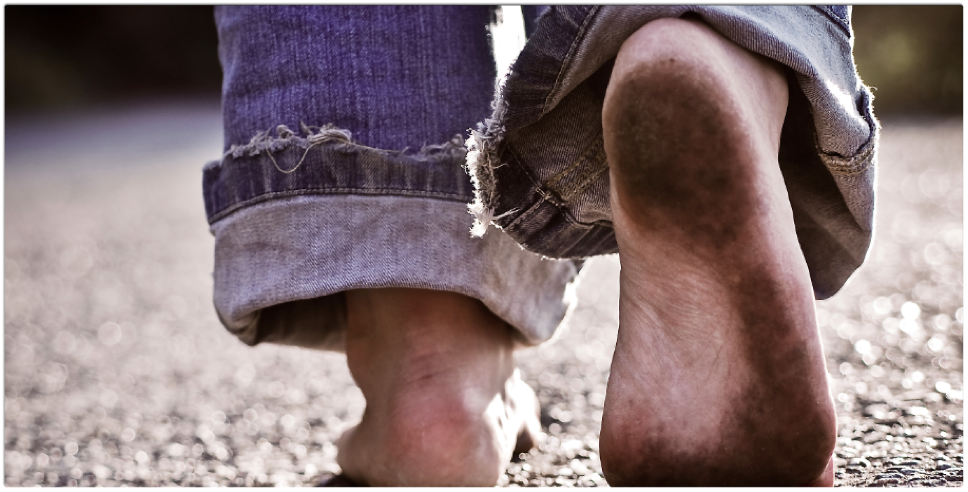
Dirty Feet

My first “formal” pilgrimage — a journey that I named pilgrimage before I embarked on it — was in 2008 on a portion of El Camino de Santiago with 14 youth and 3 other youth leaders.  I wasn’t a typical Camino pilgrim — or so I thought.  At 59 I had already had a (successful!) knee replacement, was in reasonably good physical condition, enjoyed being with teens (as a chaplain at an Episcopal girls preK-12 school, I’d had lots of exposure and loved it).  But I wondered and worried in the days preceding our flight.  Was I too old?  Would I be able to keep up?  Could I stay awake late enough into the night to keep track of the few who might try to sneak out for the freely available alcohol in “no set drinking age” Spain?

Nothing I worried about showed up on Pilgrimage (of course!).  Instead, Pilgrimage changed my life.  It has become a mission for me to share the blessings of pilgrimage with as many persons as I can: in my classes, in workshops, in conversations, in homilies.  Pilgrimage challenges the life we live so often on auto-pilot.  In a new place (whether a nearby trail, a journey to a historical site or one important to your family heritage, or a trip across the Pond to the Camino), old habits don’t fit.

We are challenged by new circumstances, difficulties to overcome, even the challenge of leaving behind your earbuds and iPhone or getting used to walking in silence.  Finding ourselves experiencing something different, we can choose to look at such challenges as torments — or chances to stretch ourselves and learn something.

We can try out a new way of seeing ourselves and the world we walk in — looking at everything that happens to us as having meaning — learning to see with the eyes of the heart as St. Benedict would say.  For instance, I learned on my pilgrimage that I could see everything that happened on my path as a metaphor for my life and as a possibility for enlightenment and growth.  The heightened awareness of being in a new place among people who spoke a different language and offered different food (octopus?  it’s really delicious!) made me aware of how back home I often preferred to stay in my comfortable routine and avoided intermingling with those whose accents or language were difficult to understand.  No more because of my pilgrimage — I am more open to difference — curious rather than shy or avoidant.

So much changed for me back home after my Pilgrimage.  I was more trusting that God was present in challenges and I was not living my life unsupported.  I was more willing to face challenges with the expectation that I would somehow grow through facing them.  I was less fearful of “what might happen” and more trusting that whatever might happen I was not alone.  I knew (and know) that I am truly loved by God.  I sense more keenly that only a thin veil divides our world from heaven.

There is so much more to say about Pilgrimage, but dinner is ready and I am ready for it.  So maybe some future blog will contain some of the rest of my Pilgrimage Truths. :^)
In the meantime, you might meditate on Kierkegaard’s admonition:

               Above all, do not lose your desire to walk . . .I have walked myself into                            my best thoughts.

A Consequential Life . . .

I recognized the key decisions of living a consequential life is:  Why am I here?  What will I do? How will I do it?  It’s a series of questions that we repeat all of our lives, especially during seasons of change.  When we find the answers, then we are assured that we are on the journey to live a consequential life. These three fundamental, but crucial questions are the map.

From: http://www.deeannturner.com/a-consequential-life-part-2/

One of the tributes I recently heard relating to John McCain, late senator from Arizona, was from Doug Ducey, current governor of Arizona.  Ducey described McCain as having lived a consequential life . . . That was a new phrase to me  and one that has resonated with me in the days since.  A consequential life . . . 

In beginning this blog entry, I googled what is a consequential life? . What came up was a bit disconcerting: consequential life cycle analysis (CLCA). CLCA is not about a life philosophy, it is about the impact on a variety of industrial outputs when an element of that manufacturing process is deleted.  ???

Of the 10 pages of google results that I reviewed, I found one reference each to Barbara Bush, Arthur Schlesinger, and Bernard Bailey as having lived a consequential life.  Not what I expected.  I was hoping for a variety of opinions on what living a consequential life might look like to various folks.  I discovered Dee Ann Turner’s essay on the questions one asks about one’s life path on that 10th page.

The idea of one’s life being consequential is akin to living one’s life in such a way to leave the world better than how you found it.  A consequential life is an intentional life, a life lived with questions and reflections on which path of many is consonant with one’s values and goals.

A definition of consequential offers synonyms like important, significant, major, momentous, weighty, memorable, far-reaching, serious.  Regardless of one’s political loyalties or religious practices, We can hardly disagree with the assessment of Barbara Bush, Arthur Schlesinger, John McCain having lived consequential lives (I don’t know Bernard Bailey’s story).  Most of us will not find ourselves in the public eye nor have opportunities to impact our world as Bush, Schlesinger, or McCain might have.  But in my mind, I can live my life with the intention of leaving my community and those with whom I interact (family, friends, acquaintances, everyday passersby) in a better place than when I arrived on this earth.  I do that through striving to glimpse the Light of God within each person I meet.  I desire to do no harm — but more than that, to do as much good as I can through reflecting on my relationships, my resources, my time, my energy.  And I know I will fail miserably quite often — but I will try anyway.

If you subscribe to the butterfly effect (Edward Lorenz: small changes can have large consequences), perhaps any encounter we have with others at any time — no matter how fleeting — can deliver unexpected consequences — can be consequential.   Yes, the briefest of encounters — how we treat a check-out clerk, whether we wave another car to go ahead of us at the 4-way stop, how we respond to a harried mom with a fussy child throwing a loud tantrum  — a frown?  or a quick “I’ve been there, I understand”?  Silly examples, perhaps, but consequential to someone’s day and also to mine.

I had to call an insurance customer service line this morning because something had triggered their system to reject my pharmacy bill.  The wait was long, the music on hold was too loud, I was annoyed and my tone of voice would have conveyed that if I hadn’t been thinking about this blog entry.  After a countdown (“you are the 4th person in line, please hold for the next available representative . . . you are the 3rd person in line, . . .”) that seemed interminable, a live voice asked how she could help me.  She couldn’t spell Moravian or Theological or Seminary and after asking me to spell them, she apologized for being “so dumb” — I told her she wasn’t dumb, just unfamiliar with the words.  She breathed a sigh and thanked me for being gracious.  I could tell that she was more relaxed and smiling — as was I because I had responded out of my better self.  We finished our business with good spirits and I felt heard and served well — no need to be irritable and pushy as I would have been had I not been thinking of the person on the other line.

If you are still reading this, I thank you.  To many folks such reflections on what is a consequential life may seem pollyanna and unimportant.  But it helped me be intentional with at least one small connection today with someone on the other end of a business call.  And I think it helped shape her day.

Jane+

Did you notice . . . ?

Kindness.hands

For each act of hatred that makes the news, a dozen of acts of goodness go unseen in our world.                           –Bishop Desmond Tutu

Each time I taught my graduate counseling class in Spiritual Formation, I would teach the spiritual practice of walking mindfully.   Students were already comfortable with sitting meditation and the breathwork that is part of mindfulness.  So after explaining that they would be going outside for 15 minutes to practice walking mindfully, I let them go to it. 

I watched them from a short distance. 

Some students walked at a very slow pace, taking their time to feel the solidity of the ground beneath them.  Some students would take off their shoes and wiggle their feet in the soft spring grass, then pick a blade, sniff it, and carry it with them as they walked.  Some students walked a couple of steps and then stopped beneath a tree or the clouded sky and gaze at what was in front of or above them for minutes at a time.  

After 15 minutes, I called them back to the classroom with a bell, and had them journal their experience.  Then, anyone who wanted to could share what this was like.

“I walk this path every day to this building, but I never noticed the dappling of shade and sun until today,” one student said.

“I heard birds calling,” another said.  “Are they always there?  I never noticed them before on campus.”

“I’m always in a rush to get to class and I realized today that I miss so much around me,” a young woman said in a choked voice. “What else am I missing?”

All of us are rushing somewhere, or caught by our screens, or thinking about what we need to do 10 minutes or an hour in the future.  What are we missing?

What small acts of kindness did we receive today that we rushed through and barely noticed?   A smile when we took our freshly brewed coffee from the clerk at the coffee shop?  A door held open by . . . was it a boy or a woman?  We didn’t notice.  

A maintenance person whistling while emptying the circular files in the computer room?  A girl with a My Little Pony backpack stooping down repeatedly to pick up pieces of paper trash and running to the trash can at the end of the parking lot to toss her balled up trash in it, yelling “Score!”  

Little pieces of goodness all around us.  I’m betting there are 10 . . . 15 . . . maybe more every day that I fail to notice — and fail to affirm.    Affirming, noticing, appreciating with words or gestures adds positive energy to those small acts of goodness and establishes a connection with the person offering goodness.   

In times like these when it seems easier to see the world filled with dark, diminishing, and destructive words and acts that tear down rather than build up, perhaps small acts of goodness that are barely noticeable can offer hope that love and light can win.

Resilience, Ambiguity . . . and Hope

They tried to bury us; they didn’t know we were seeds.                                                     (Mexican proverb)                               

Maybe “they” didn’t know we were seeds.  Did we?  

To believe we can survive and grow when all seems lost requires hope.  Hope comes from experience we reflect upon . . . living through difficult events, challenges, losses, or woundings.  In the early moments of the difficult, we may feel unequal to it, perhaps overwhelmed, perhaps pretending or hoping that it is an illusion and will soon fade away.  But when we have experienced and faced a challenge and come through it — whatever scars we may carry — we can know for future events that feeling unequal or overwhelmed and having no idea how to survive the difficulty is just that — a feeling and not a reality. We can trust that step by step, somehow, some way we can move through the challenge and find a way to continue our journey.

I learn that lesson again and again as I live into my later years.  Each time life challenges me with another difficulty (small or large) I look back to difficulties I have faced in the past and find hope that carries me through the time of unknowing until I reach a place where the path becomes clearer.  I may have to let go of some things that have been important to me, that I thought I could not live without.  But I find out of those experiences of challenge has always come what I have called at various times nuggets of wisdom or pilgrimage truths.  

William Bridges, author of The Way of Transition has guided me in that process.  Bridges distills our human responses to challenges or changes into three internal transitional phases: Ending/Losing/ Letting Go, The Neutral Zone, and New Beginnings.

Events, difficulties, challenges happen to us. We usually have little control over such change events.  Transition, unlike external change events, is the psychological and internal response to external changes.  Transition theory begins with a jolt of change that disrupts our lives in some way. The change may be big enough to rock our foundations or it may be a seemingly small change that calls for just a slight shift.  We may feel capable of adjusting relatively quickly or we may need to allow ourselves time to catch our breath, cling to something solid, and feel our feelings.  Whatever the change, we need to take stock of what is left and what is gone, what we will need to take with us into the future and what we need to let go of.  This first phase is painful and difficult for most of us.  We may feel anger bubbling up unbidden, we may be irritable and prickly towards loved ones, our tears may well up without warning, our energy may flag, our optimism may be lost.  Go with these feelings, knowing they are normal.  They will not last forever.  Slowly and honestly, take stock, find what matters, let go of the rest. . .

The next phase of Transition according to Bridges is The Neutral Zone.  We have let go of the past, yet there is no new beginning — nothing that we can grab hold of.  We are in between and it feels scary.  It feels, too, like there is no way out of this in between time and we feel trapped and discouraged.  This Neutral Zone is always for me a place of confusion, a bit of panic (will there be a future?  how do I prepare if I don’t know for what?).  Yet, if I “trust the process” and let it unfold (perhaps in collaboration with others) and if I call on who I am and what I need and can give, the Neutral Zone is a place where energy stirs and creativity pokes through with new possibilities.  Such creative new beginnings are only possible if we trust that panic and confusion are part of this and that out of that state will emerge something new.  Is this totally Pollyanna?  Not at all.  In every ending is a new beginning that will grow and enrich us if we do not succumb to the siren song of quick fixes.  If we can allow ourselves to live in ambiguity, in not-knowing, our innate human drive for growth will eventually begin to offer up creative insight, and new possibilities.

The New Beginning emerges — always.  This is what one learns through experiences of change and inner psychological transition.  It may not be what we expected, but it will give us life.  This is the grounded hope that we can trust when we have lived through this transitional process in the past and consciously affirmed the process in reflection.   If we have been fortunate to not yet live through difficult change in  our lives, we can learn this process and perhaps tuck it away in the back of our awareness for retrieval when we need it.  

Many times after I have shared my story with someone, they have been surprised at my willingness to accompany others through their deep and tragic challenges while also maintaining an everyday optimism and cheer. They often say they could not have lived through the experiences I have described.  I know that we can live through almost anything with the grounded hope and conviction that something is to be learned from transition, and that new beginnings will always follow endings.

Jane

Grief

Grief

I need someone who believes that the sun will rise again, but who does not fear my darkness. . . Someone who can stand in thunder and watch the lightning and believe in a rainbow.    (Fr. Joe Mahoney)

Grief is one of the loneliest experiences one can have in our “I can handle this — I’m OK”, death-defying American culture.   Many of us run from the grief of a friend and even pretend that we haven’t noticed their pain. We try to distance from the grieving by making sense of it with one of many inanities: “She’s better off now and isn’t in pain”, or “Don’t cry.  He’s in heaven with God,” or “Your little girl is a flower in God’s garden now.”  Our corporate culture gives us 3 days of bereavement leave and assumes we should be all over our grief after that. 

Not at all!   Grief opens a trap door into deep darkness where we search desperately for the path that will return us to the life we knew — but we cannot find it.  And indeed there is no path back to the life we once knew.  That life is gone forever because of our loss.  We want our dinner table to have the same faces around it — but someone is missing.  We want our self-confidence back after the loss of a job, and yet when we bump into a former co-worker at the grocery store, we turn down another aisle hoping that she hasn’t seen us.  We feel an urgency to make a friend more comfortable by reassuring him that we are just fine even though our sad eyes betray the lie.

I need someone who believes that the sun will rise again, but who does not fear my darkness.

Yes, I need someone who can allow my tears to flow.  I need someone who doesn’t feel the tug to cheer me up.  I need someone who can just hold me safely and firmly in a hug that lasts long enough for me to relax into it and trust the closeness.

I need someone who has faced the darkness of loss in their own life, who knows the pain is deep and real, and yet who knows — at a cellular level — that however long the darkness of grief lasts for me or for anyone, healing will follow, and I will laugh again.  It is only someone who has felt the numbness and darkness of loss suck them  into the dark, bottomless pit. . . one who has waited, longed to find, yearned for the path that travels toward light again . . . only that one can truly bear witness with their presence alongside another’s grief that joy will come with the morning (Psalm 30:5).

. . .Someone who can stand in thunder and watch the lightning and believe in a rainbow.

The path toward the light and toward life again is not backward toward restoring what was.  The path toward the light is a path toward a life that is different in some way.  Grief changes us.   Loss (whatever has been lost) has taken something from us.  Over time as healing comes, we can learn something about our resilience, creativity, faith, hope, love.  Love will connect us forever with what we have lost., if we wish that.  Memories will remain.  But we will need to move forward with our lives, looking for a way to use the lessons of loss and survival in ways that may help others.  We can create meaningful action from the hard won struggle that heals.

I pray that when we heal from our own losses, we may become persons who, having heard the thunder and seen the lightning, still watch for the rainbows.  May we be the ones who can be present in another’s darkness without fear, knowing the sunrise is just over the horizon.

Jane