Five Lines . . .

I just learned about Cinquains . . . five lines of prose that begins with a single noun and the rest of the lines describing it. I’m not a poet. I’m not even a consistent writer on this blog. But writing Cinquains appeals to me because it is simple, accessible, and beautiful in its simplicity.

Here are the guidelines:

Line 1: A single noun . Line 2: Two adjectives describing the noun . Line 3: Three gerunds (action verbs ending in -ing) . Line 4: A sentence or phrase of just 4 words telling how you feel about the noun. Line 5: A synonym of line one.

Try one. They are fun, and sometimes surprisingly insightful. I am no poet, but here are some I’ve played with:

Time.
Moments.Unstoppable.
Filling. Measuring. Disappearing.
Faster and faster now.
Instantly.
Blue.
Cobalt.Sapphire.
Flying.Collapsing.Dying.
The color of 9/11.
Mourning.
Morning.
Fresh.Lightfilled.
Birthing.Rising.Beginning.
Always new, always surprising.
Hopeful.


9/11

Reading the date, I saw in my memory that whole horrific morning and felt again the terror and threat that overwhelmed me on that blue sky day.

That is what I remember . . . that blue sky. Intensely blue. Purely blue. No clouds or contrail of exhaust. Just blue. Piercing, penetrating blue.

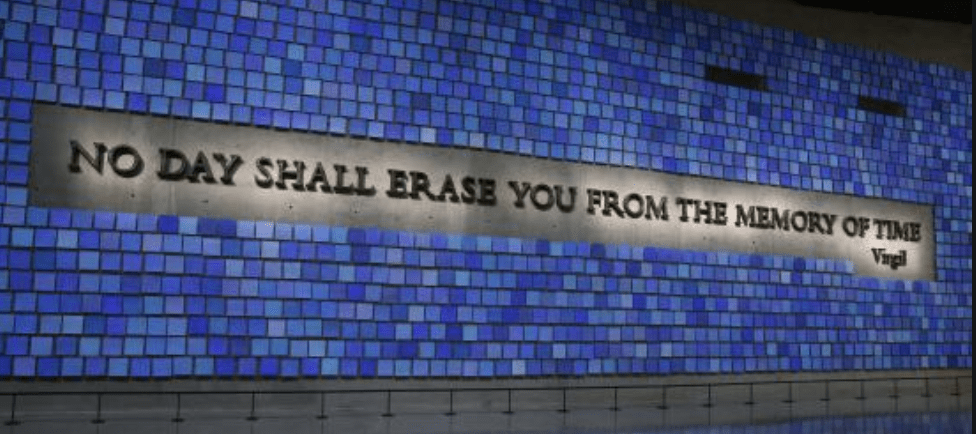
When we visited the Ground Zero Memorial several years ago, I stopped before this wall, unable to pass by. A collage of nearly 3000 watercolor squares in an attempt to capture that color. Piercing, penetrating shades of blue. Like that morning on 9/11. No clouds or contrails of exhaust. Just blue.

And I breathed the blue into my body, feeling the peaceful beauty of pure color fill me. Having walked through the misshapen pieces of tragedy — steel beams twisted and torqued by impact and fire, a searing picture of someone standing in the hole left in the side of the building and about to jump, the dented and damaged stairs from one of the towers — the serenity of the blue sky that day was a gift.

Was that what they saw in their last moments in this life? Foolishly perhaps, I would like to believe that was a part of their awareness. Some brief moment of blue sky . . .

Mountains

I always thought it odd that the Poconos (in northern Pennsylvania) were called mountains. In actuality, they are no more than hills and have a highest elevation of 2200′ +/-.

When I was growing up, my family lived for awhile in central Washington state — sagebrush country and desert. But we had to travel to visit relatives by going through real mountains — the Rockies — and did that several times over the 4 years we were out west. I remember in my mind’s eye the amazing view of the Rockies as we drove west on the flat prairie of eastern Colorado.

At first, the tops of the Rockies looked like small hills, but the further west we drove, the higher they rose in front of us until — miles out from the foot of the mountains they became riveting in their height and hazy blue color. We were a day’s journey from them as we watched with wonder at the height and sharpness of their peaks. And then, we knew, we had to drive through them.

I remember dark tunnels bored out of rock and twisty roads and a hairpin curve that scared my eight year old self. I remember my mother (and me, too) turning from the window and not looking down at the drop of thousands of feet to our right.

The Rockies. Those are mountains — 14,000′ plus! I would love to see them again!

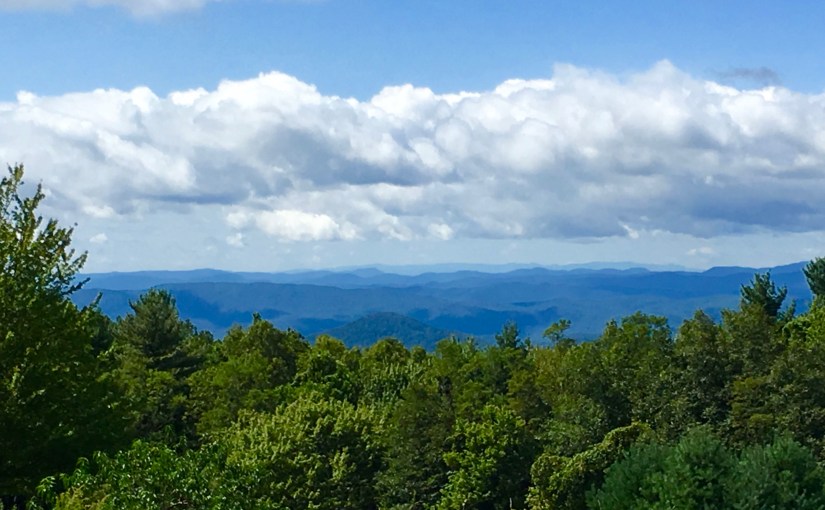
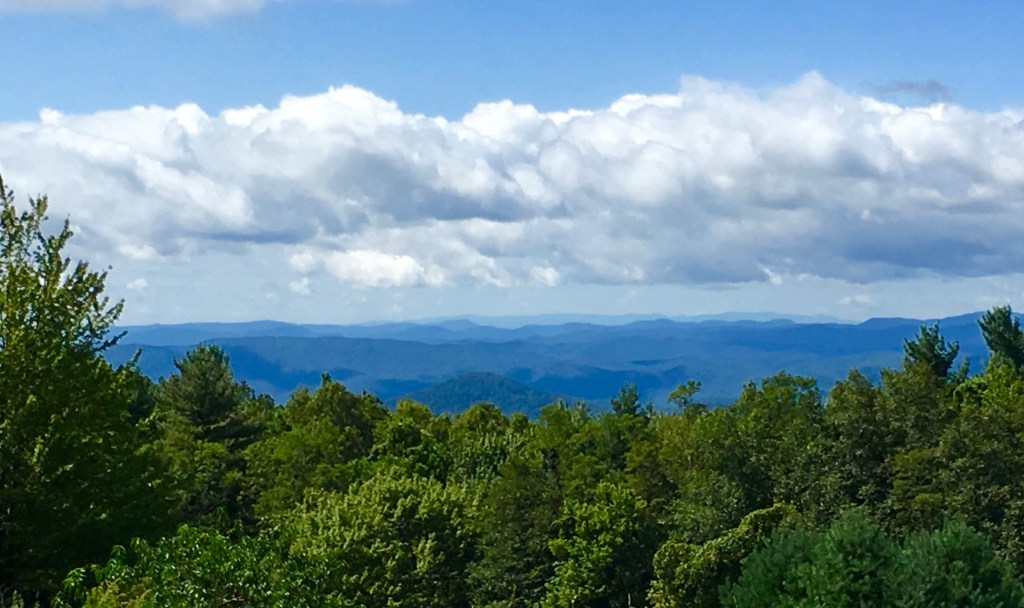
I just got back from a retreat I led in the Blue Ridge Mountains. These ridges deserve to be called mountains as well, although the highest peaks among them are just over 6,600′. They are older than the Rockies and time has ground them down to slightly rounded tops (unlike the jaggedness of the Rockies) and lesser heights. But their valleys are narrow and the sides of the mountains rise steeply from the valley floors. The summits are often shrouded in mist and wind-raked. And blue (see picture above). The Blue Ridge nickname is earned by the isoprene (a product of tree metabolism — beyond that, I don’t know . . . ) given off by trees that reflects blue light. The color is spellbinding and captures one’s attention because of the unusual color. And the shades of blue are multihued giving depth to the scene of multiple ridges layered into the distance.

Whether you are a flatlander or a mountaineer — or perhaps a hills and valleys person — I hope you will delight in looking around you after you read this and wonder in the God-created geography that surrounds you.

Awakening to Moonlight

The past several nights, I have awakened just after midnight to moonlight streaming through our bedroom window. I have been entranced with its brightness — bright enough to throw shadows onto the lawn as I peek out the second floor bedroom window.

I never knew the moon to be so bright. But then, I don’t think I ever paid attention to the strength of moonlight before. When my eyes are adjusted to darkness, the moon’s light is strong enough to walk safely and able to spot any obstacles like the gaping potholes at the end of this winter, or stones churned up by the snow plow and thrown onto the road’s edge. The moon’s light is probably strong enough to do yardwork, if I were so inclined to leave my warm bed and get dressed in the chill of my house at night.

The moon is said to be a symbol of feminine energy and monthly cycles. Supposedly the moon was created as a “secondary”, less bright light than the sun which is said to be a symbol of male energy. Yet the light I am entranced by as I awake to it does not seem to take second fiddle to the sun at all. Moonlight is soft yet bright. It changes through the lunar cycle, never the same any single night. It rises and sets in different places through the year and its timing shifts as well. It does not share its light with an “in your face” brightness — rather it gives just enough light that I can see something but only with soft edges, not well-defined boundaries. And the softness of its light — even at full moon — makes me “work” to see things and know what they are. I have to want to see before my eyes focus and my brain discerns the outlines shown in the fainter light.

The sun’s light can blind one with light, moonlight reveals.

And the moon overcomes the sun in periodic eclipses, blocking the bright light of the sun for a few stunning moments of awe. . .the “secondary” light showing its subtle strength for all to see as though to say, “Each of us has our gifts. One is not stronger, of more value, than another. Remember . . .”

In Grief — You Are Not Lost

Lost
Stand still. The trees ahead and bushes beside you
Are not lost. Wherever you are is called Here,
And you must treat it as a powerful stranger,
Must ask permission to know it and be known.
The forest breathes. Listen. It answers,
I have made this place around you.
If you leave it, you may come back again, saying Here.
No two trees are the same to Raven.
No two branches are the same to Wren.
If what a tree or a bush does is lost on you,
You are surely lost. Stand still. The forest knows
Where you are. you must let it find you.

 –David Wagoner . Collected Poems 1956-1976

A friend of ours died last week of FTD . . . Fronto Temporal Dementia. FTD is an awful disease that steals yourself – who you are, your personality, your values — and leaves you with your memories fairly intact (unlike Alzheimer’s dementia).  It was awful to watch him lose himself as the disease took hold.  Scary,  heartbreaking, unreal . . . almost like he was possessed by some spirit that took over his body.  His wife and son and daughter-in-law cared for him at home, eventually having to install locks on the refrigerator and cabinets to prevent him from ravenously eating everything — literally.  He wandered and they had to follow him or distract him every moment.  This man who had been a well known photographer and collector became unable to hold his camera still and uninterested in his art.  He was unaware of others’ feelings and uncensored in what hurtful things he said to his wife and son.  

Hospice came and helped with his care a couple of times during the week, and offered one week of respite care so his wife could leave his side and try to escape for a brief time the nightmare that was closing in.

After 10+ years the nightmare ended with our friend’s death.  But for his wife, it continues.  She lost her husband long before he died.  She felt her grief had already overtopped any measure and that after he died there would be relief.  Instead, waves of grief accosted her relentlessly.

When she called me panicked at the myriad of feelings she was experiencing, I was able to reassure her that she was not going crazy.   I, too, had grieved the death of a spouse and knew the terror of uncontrollable and unwelcome feelings that come after the death of a loved one. . .sadness, emptiness, anger, confusion, restlessness, inability to concentrate.  All of them normal, and all of them horribly uncomfortable.  And all of them making the griever question one’s sanity and whether there is enough strength and energy to withstand the waves of feelings.

What surprised me as her friend was not the intensity of her feelings, but my realization that I knew at a gut level that this was not the ending of her ordeal but the beginning.  She would be in for a difficult and painful ride that no one could take away. 

Grief takes us and wrings all the energy and hope out of us, leaving painful empty spaces that we can only fill over time.  Over time, the aches of those empty places fill with new friendships, experiences, goals, hopes that soothe and nurture our emerging self.  And we reclaim and integrate into ourselves “old” parts of ourselves that fit whom we have become.  It is not a painless process but a kind of re-birth/resurrection that comes of the grief process.  

It helps to understand grief as a dual process oscillating between a painful letting go of what was and a dawning of new identity and energy.  It is not something we can “manage” except by allowing the waves of letting go roll over us (knowing they will not last forever) and enjoying the moments of energy and joy (knowing they will come more frequently and eventually become a new normal).

Blessings on all who are in grief this day.  Although a part of you has died — yet a part of you is being reborn.  I promise you.

 

Vigil

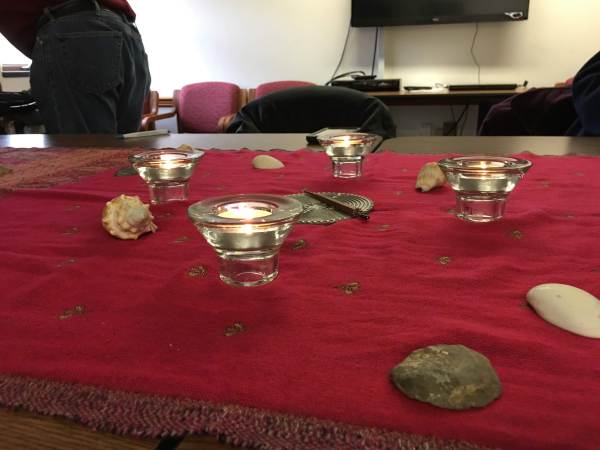
I attended a vigil in memory of those killed in the Pittsburgh shooting — and to show solidarity with my Jewish brothers and sisters.  It was packed!  Standing room only.

img_0587

  And I felt such joy, even at this solemn occasion.  I puzzled last night about why I would feel joy.  And was it appropriate?  Or did it insult others who were there to grieve?

It was not that I was not sad or hurting or heartsick over these deaths. Rather, I was overjoyed to not be alone in grieving what we have lost as a nation. There are many of us who are searching for a way to demonstrate that we will not be a part of the prejudice and incivility and violence that is destroying the soul of America.  And last night gave us a way to say that by simply showing up.  Hugs and tears and candles and photos and prayers and kaddish for the dead and song.  We spoke through all of these.

So many people I knew last night.  So many people who had been moved to come and stand with others who value and dream of a world where differences are respected, and commonalities emphasized.  A world where curiosity replaces fear and where we are moved to inquire about other’s stories (and tell our own) rather than move apart and judge each other from a distance.

Grief was appropriate.  And joy as well.

Blessings,

Jane+

Who have we become?

As I write today, there is news of 5 (now, 6) “bombs” found to be addressed and sent to well-known Democratic figures.  Luckily, they have been found before being touched by the addressees — and no one is saying, yet, whether they would have exploded if opened.

Were they born of hatred?  Were they imagined in the mind of a demented or mentally ill person?  Were they concocted as a response to the White House allegations of “fake news” or Democrats labeled as a “mob”?  

It would be easy for me to succumb to conspiracy theories and think that maybe it is a ploy for Trump to call for martial law.  But then I would be no better than those who write online and suggest wild conspiracies on the left.  

It is distressing that our country is so divided and that we tend to gather with those whose politics is like ours.  I am often afraid of others whose politics is volatile and different than mine.  It is distressing that there is such hatred and mistrust among us.  

I feel I do not know this country and my fellow citizens any longer.  Will we ever be able to rebound from the hatred and division to find common values and to rebuild trust?  What can I do to maintain that hope?

Sadness

How can the love for a pet run so deep?  How do we fall so fully in love with an animal that they seem almost human in their understanding of our moods? How does it happen that as our pet sits silently looking at us, we forget they can’t verbalize, and we want to say “what?  what do you want?”

Ms. Kitty has been part of our family since 2001.  She initially had to find her place among three pets at the beginning.  Then when our daughter took one of our cats to her home, Ms Kitty had only one, Baxter, to contend with.

Cat pic

Baxter was gentle and loved other cats . . . Ms Kitty not so much.  She didn’t start a fight, never was aggressive, but if Baxter happened to walk in her space, she would hiss and he learned to tiptoe around her.  Baxter was a lap sitter, and while he was with us, Ms. Kitty would just look at us with Baxter on one of our laps, and glare.  She never tried coming up to sit on the empty lap.  Just glared.

Likewise, when guests and friends came to visit, she would not hide like some cats would do, but instead stayed put (on a chair, by the fire on a rug, anywhere) and hissed vehemently.  “Stay away” was all she meant — she never attacked anyone unless they tried to ignore her hissing and pet her.  She just wanted distance from any human and any animal.

When we finally and sadly had to put Baxter down, Ms Kitty became a changed cat.  She immediately claimed our lap whenever we sat down, purring contentedly and falling asleep.  She still hissed at friends who dropped by, but for us she was the cuddliest cat we had ever had.  At night, she would come up beside me on the bed and snuggle into the crook of my arm and fall asleep. . .sometimes for the whole night!  She was a great friend and confidante.  I trust that she ever divulged a secret I whispered to her. . .

This week she has been leaving us . . . she is dying, slowly but peacefully, here at home.  My heart breaks as I see her growing thinner and struggling to walk on weakened limbs.  Sometime over the next week, she will take her last breath.  She will be gone but my grief will continue.  And she will be remembered always.  A precious, loved cat.  Always.

From Curiosity into Love

The surprises I’ve experienced in my writing practice have dislodged me from curiosity into love.           –Layli Long Soldier                                                                 (Lakota Poet interviewed by Krista Tippett)

Curiosity

I have taught counseling students that their initial attitude toward their clients upon the first meeting should be curiosity.  Curiosity about someone requires a stance of unknowing.  One who enters a relationship of any kind with curiosity is saying, “I want to know you.  I am listening.  I don’t know who you are and what you love, what you think, what soothes you, what scares you.  I want to know.  I’m here.  Please share what you can.”

The stance of curiosity in a counseling relationship, or any intimate relationship, is something that usually has to be learned and practiced because it doesn’t come naturally.  I believe most of us most of the time encounter another person whom we don’t know assuming something about them.  Almost unconsciously, we look at a person, at the clothes they are wearing, at their grooming, notice the color of their skin, their posture . . . and we make assumptions about this person.  Our amygdala at work, probably, sizing up another being to see if there is threat or not.  It is normal — I do it, you do it.  And in itself this automatic reaction is not bad.  It is only destructive if it is unconscious and not brought to our awareness.  Unconscious assumptions cannot be challenged nor evaluated for accuracy.

In therapy, if we therapists are not aware of our assumptions about a client, we cannot be helpful to them.  Our curiosity is a part of the healing skills we offer as we help them explore, discover, and tell us who they are.  They then can make courageous choices that are more consonant with who they know themselves to be.

As we participate in the process of learning one’s own story and honoring one’s identity,  our curiosity often becomes love.  By love I mean deep resonance and respect for another’s willingness to explore what may be painful experiences or choices.  Knowing someone deeply (as our curiosity and the other’s trust allows us to do) opens the door for loving the humanity, courage, and trust that another may place in us.  

I am grateful to the many clients and directees who have allowed me to witness to their journey toward wholeness.   Through my work as therapist and spiritual director the capacity to live my life with greater curiosity and love in all my relationships continues to grow and change me for the better.

Truth

The hardest part of writing is telling the truth.       –Sue Monk Kidd

I have not written lately, and perhaps I have lost you, my reader.  I have been painfully following the latest news commentary on the confirmation hearings for Supreme Court justice and the chaos that has ensued from the appearance of one and now two women who are accusing a potential Justice of sexual assault.  It has been disturbing and upsetting to me as it triggers memories I don’t want to remember.  

The memories are not new.  But I had buried them after each of them happened  — not even realizing what they were and not naming them sexual assault or sexual misconduct because I felt ashamed and responsible for not preventing them or knowing they might happen if I were in a certain situation.  As though I should have had a bit of God’s omnipotence to know what was about to happen.

The first I remember was when I was 16 and working a few hours a week as a cub reporter at our small town daily newspaper.  My editor assigned me to cover a Veterans Day Parade and I was to ride in a car with a 60-ish VFW member.  I climbed in the front seat, dressed in a modest Sunday dress and with my wooden pencil and lined notebook in hand.  As we drove the parade route, windows up because of the November chill, my “host” asked my name and grade in school and how our football team was doing.  I thought we were having a normal conversation and answered his questions.  In the same tone of voice, he said he had always wondered what color pubic hair a blonde and a red head had, did I know?  I could feel myself blush scarlet.  I felt stunned.  Was this ok? Is this how older men talk?  What should I do or say?  I stared at my lap and squiggled a doodle on the tablet.  “Well?” he said.

I had never been on a date.  I was very shy.  Writing was my outlet — I was much more comfortable with writing than with conversation.  I was a pastor’s daughter whose upbringing taught me that I was to make others comfortable and always try to understand things from other people’s point of view rather than challenge or disagree with them.  And I had learned those lessons well.

“You’re awful quiet over there,” he chided.  “And awful pretty.”  

I had never felt pretty.  I just wanted to get out of the car and run.  But “try to understand and don’t challenge him” were what came naturally at that point.  

“I don’t know the answer to your question, Sir,” I said without looking at him.  

He continued asking lewd questions.  I sat with my head down and tears coming and praying for the end of the ride.  We finally arrived at the VFW where the parade ended.  He invited me to go in to the bar with him.  Without looking at him, I opened the car door, jumped out, and ran and walked a block toward Teti’s pharmacy where there was a pay phone to call my Dad to pick me up as promised.

Until now, I never told this story except to my sister and husband.  And the awful thing is that it lay buried deeply in me until #MeToo burst on the scene.  Only then did I recognize it as the first of many boundary violations that have happened to me.  I was lucky, I know, that this was only words and not a rape attempt.  But the feeling of being trapped in that car, with a man whom I was supposed to trust as a benign helper in my cub reporter job while he enjoyed my discomfort with sexual innuendoes stays with me today.  It was the beginning of not trusting men, avoiding being alone with them, and feeling like a 16 year old when I have to be.   

Why is it so hard for so many men to understand the impact of the much more serious traumas that Dr. Ford and Ms. Ramirez are telling them?  Why must so many people minimize their stories as “just horsing around” — or worse yet, made up?  I know some of you who read this will figure that it is just “politics as usual.”  I want to know: what does it take to listen to someone with compassion and allow yourself to resonate with the feelings that come from such horrid events, however “insignificant” they may seem?

Jane+