
While the word change normally refers to new beginnings, real transformation happens more often when something falls apart.
Richard Rohr
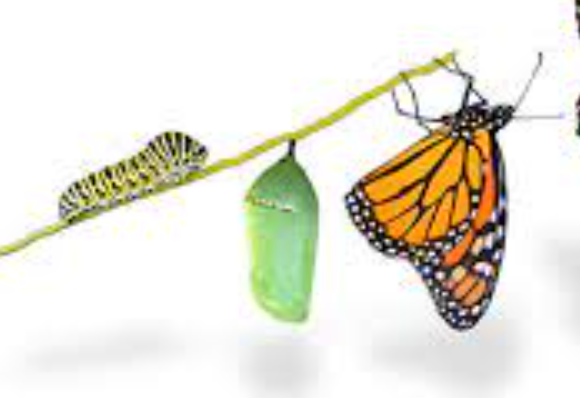
Change is inevitable. It is a necessary part of living — as necessary as shedding its too-tight skin is for the caterpillar.
The remarkable process of transformation begins with change but over time moves inevitably through three stages. Change is at the start and begins with losing something or someone essential (or at least very important) to us. With the loss we leave the familiar and enter an unknown territory — lost without a map to discern where we have landed or to guide us to back to the familiar. We want to “go home” but we have not yet realized that we cannot go home again. We don’t trust that we can find our way — either back to the familiar or forward to something new and survivable. When we are about to give up hope, there comes a faint glimmer of possibility — and if we move however cautiously towards it we find ourselves coming into a new space that beckons us to a more expansive life than we could have imagined possible before.
Yet transformation begins with pain — with the death of what served us well in the past but has constricted life in the present. Like the caterpillar that feels an irresistable drive to slip off its caterpillar identity and reveal the chrysalis beneath, transformation is not something we initially welcome but an involuntary entry into unknown territory. It often arrives with that heart-stopping “sound” of something precious cracking open, breaking. It commands our attention — we cannot ignore it. It might come as a life threatening diagnosis, a loss of a job we thought was secure, a sinkhole appearing under our home’s foundation, a pandemic shut down that isolates us from loved ones. When we realize what is being broken, our human response is to rush toward what is breaking open and fix it or repair it as we would a wound or hold onto it so it won’t go away. And that may work for awhile, but such “fixes” cannot hold the life force that is expanding beyond what contained it and will eventually open to new ways of seeing and being in our world. Transformation, in my experience, begins there, with that cracking open of something we have relied upon and thought was unchangeable but may no longer serve us — whether we realize it or not.
While we are in the middle of the transformation process, we cannot see those possibilities or new visions anymore than a 5 year old girl can imagine the pleasure and pain of a body that experiences pregnancy and birth.
What has given me hope in the midst of the many transformation processes I’ve experienced is knowing these three stages have always been part of whatever has at first felt like loss. From a long life filled with repeated experiences of the transformation process, I have learned I can trust that there will always — however long it takes — be a richer part of life after I have let go of what has been.
Letting go is always bittersweet and sometimes downright awful and wrenching. And I can truthfully tell you that there is nothing that makes that part easier — or that ends the longing to “go back” in some fashion to revisit what I had or who I was. But knowing that the process of transformation will inevitably open to something life giving helps me to slowly let go of what was and turn away from looking back. I can dwell in what is not yet clear when I trust that in the cosmic cycle of loss, chaos, and renewal there will yet be new life that I cannot even imagine. Even in death.

 Pilgrimages and Paths